
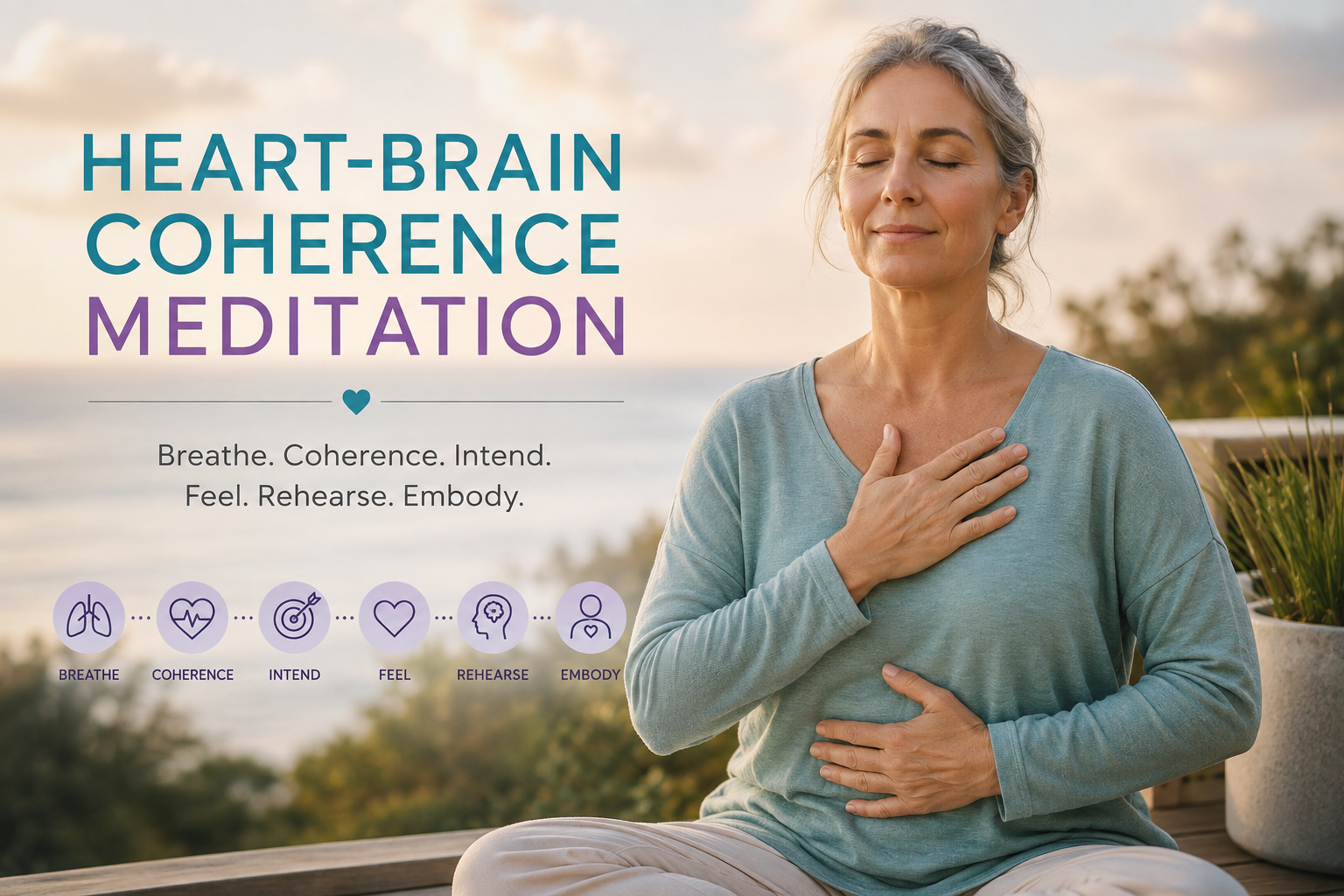
Heart-brain coherence meditation is a mind–body practice that brings together breathing, heart rhythm, attention, intention, body awareness, mental imagery and emotion.
HBC Dynamic Meditation uses slow, heart-focused breathing alongside interoceptive awareness, mental rehearsal and intentional emotional states. Rather than simply observing thoughts as they arise, the practice encourages us to become more aware of our internal state and learn how to intentionally shift it.
At its heart is a simple idea: Breathe. Coherence. Intend. Feel. Rehearse. Embody.
What Is Heart-Brain Coherence Meditation?
Heart-brain coherence meditation combines several practices that have traditionally been explored separately.
These include:
- slow, focused breathing
- awareness of heart rhythm
- attention and intention
- awareness of sensations within the body
- mental imagery and rehearsal
- intentionally cultivating positive or elevated emotional states
The aim is not to force the mind to become completely still. Instead, HBC Dynamic Meditation involves actively working with the body, attention and emotional state.
This makes it different from meditation practices that focus primarily on observing thoughts without attempting to influence them.
How HBC Dynamic Meditation Works
One of the foundations of HBC Dynamic Meditation is slow, regulated breathing.
Breathing happens automatically, yet it is also something we can consciously influence. By deliberately slowing and regulating the breath, we can affect processes connected with the autonomic nervous system.
The autonomic nervous system, or ANS, helps regulate many functions that happen without conscious effort, including:
- heart rate
- breathing
- digestion
- aspects of the body’s stress response
Slow, controlled breathing can also influence heart rate variability, commonly known as HRV.
HRV refers to the natural variation in time between heartbeats and is widely studied as an indicator of autonomic nervous system activity.
A 2022 systematic review and meta-analysis examined 223 studies investigating voluntary slow breathing and heart rate variability. The researchers found increases in vagally mediated HRV during slow breathing, immediately after a breathing session and following repeated practice.
This research supports the connection between slow breathing and changes in autonomic regulation, although it does not mean that breathing practices can treat cancer or replace medical care.
Research: Laborde S, et al. Effects of voluntary slow breathing on heart rate and heart rate variability: A systematic review and a meta-analysis. Neuroscience & Biobehavioural Reviews. 2022.
For further information about the relationship between breathing, heart rate variability and autonomic regulation, you can read more about the research here.
Breathing and Heart-Brain Coherence
In HBC Dynamic Meditation, breathing becomes a way of bringing attention back to the body.
Rather than breathing mechanically, the practitioner slows the breath and directs awareness towards the heart area.
This creates an opportunity to move away from an automatic or highly reactive state and towards greater awareness of what is happening internally.
The practice describes this process as developing coherence — creating a more regulated internal state before introducing intention, imagery or mental rehearsal.
Attention, Intention and Mental Rehearsal
Once breathing has slowed and attention has become more settled, HBC Dynamic Meditation introduces a clear intention.
This may involve mentally rehearsing an experience, behaviour, response or desired internal state.
Mental rehearsal is the process of imagining an action or experience without physically performing it. It asks the practitioner to become actively involved in the experience rather than simply thinking about an outcome.
The intention is then combined with emotion.
In other words, the practice is not simply about imagining what we would like to experience. It also encourages us to explore what that experience might feel like.
The Role of Interoceptive Awareness
Another important part of heart-brain coherence meditation is interoception.
Interoception refers to our awareness of sensations arising from within the body.
These might include:
- breathing
- heartbeat
- muscle tension
- warmth
- physical comfort or discomfort
- subtle changes in emotional state
Developing greater awareness of these sensations may help a person recognise changes in their internal state earlier.
Instead of operating entirely on autopilot, the practice encourages us to notice what is happening within the body and respond intentionally.
Intention, Emotion and Embodiment
HBC Dynamic Meditation also incorporates what the source material describes as elevated emotions.
Rather than focusing only on changing thoughts, the practice asks the person to explore an emotional state associated with their intention.
For example, someone might consciously focus on feelings such as calm, gratitude, compassion or confidence while mentally rehearsing an intention.
The final step is embodiment.
This means moving beyond simply thinking about a different internal state and practising the experience of that state through breath, body awareness, imagery and emotion.
It reflects one of the central ideas behind HBC Dynamic Meditation:
It is not simply about changing what we think. It is about learning to change the state from which we think, feel and act.
Heart-Brain Coherence Meditation and Neuroplasticity
Repeated experiences and behaviours can contribute to neuroplasticity, the brain’s ability to form, strengthen and reorganise neural connections.
The HBC Dynamic Meditation framework proposes that repeated mental rehearsal, emotional experiences and intentional regulation may support the development of new patterns over time.
The source material also discusses possible connections between repeated mind–body practices and stress-related neuroendocrine and immune pathways involved in gene expression.
These are complex areas of scientific investigation. They should not be interpreted to mean that meditation can treat cancer, change cancer outcomes or replace medical treatment.
Instead, HBC Dynamic Meditation is best understood as a mind–body wellbeing practice.
A Flexible Approach to Meditation
One of the features of HBC Dynamic Meditation is its flexibility.
There is no requirement to follow exactly the same routine every time.
Different approaches can be combined depending on the person’s intention, including:
- breathing techniques
- meditation
- visualisation
- body awareness
- mental rehearsal
- emotional awareness
Once the principles have been learned, the practice can also be used without music, technology or specialised equipment.
This means it can potentially become a simple practice that is available wherever and whenever someone chooses to use it.
Ancient Principles Through a Modern Lens
Many of the ideas found within HBC Dynamic Meditation are not entirely new.
Breath regulation, body awareness and contemplative practices have been explored for centuries through traditions including pranayama and other forms of meditation.
HBC Dynamic Meditation brings elements of these practices together with contemporary concepts including:
- autonomic regulation
- interoception
- neuroplasticity
- psychophysiology
In this way, it provides a modern framework for exploring the relationship between breath, body, attention, thought and emotion.
Using Meditation Alongside Cancer Care
For people affected by cancer, meditation and other mind–body practices may form part of a broader approach to personal wellbeing.
However, HBC Dynamic Meditation is not a cancer treatment and should not be regarded as an alternative to conventional medical care.
Every person’s circumstances are different. If you are living with cancer or undergoing treatment, speak with your healthcare team about complementary practices you are considering, particularly if you have questions about how they may fit alongside your current care.
At CanSurvive, our aim is to provide information and education that helps people explore different aspects of complementary and whole-person cancer care while remaining informed and involved in their healthcare decisions.
Breathe. Coherence. Intend. Feel. Rehearse. Embody.
HBC Dynamic Meditation encourages us to become more aware of the relationship between breathing, physical sensations, thoughts and emotions.
Rather than trying simply to control our thoughts, it offers a structured way to explore the internal state from which those thoughts and responses arise.
With practice, the process becomes:
Breathe. Coherence. Intend. Feel. Rehearse. Embody.
It is an invitation to become more aware of our internal experience — and to practise responding to that experience with greater intention.
Source: CanSurvive Malaysia, Heart–Brain Coherence (HBC) Dynamic Meditation.
Disclaimer: This information is provided for educational purposes only and does not constitute medical advice. HBC Dynamic Meditation is not a cancer treatment and should not replace medical care. Please discuss treatment decisions and complementary practices with your healthcare team.