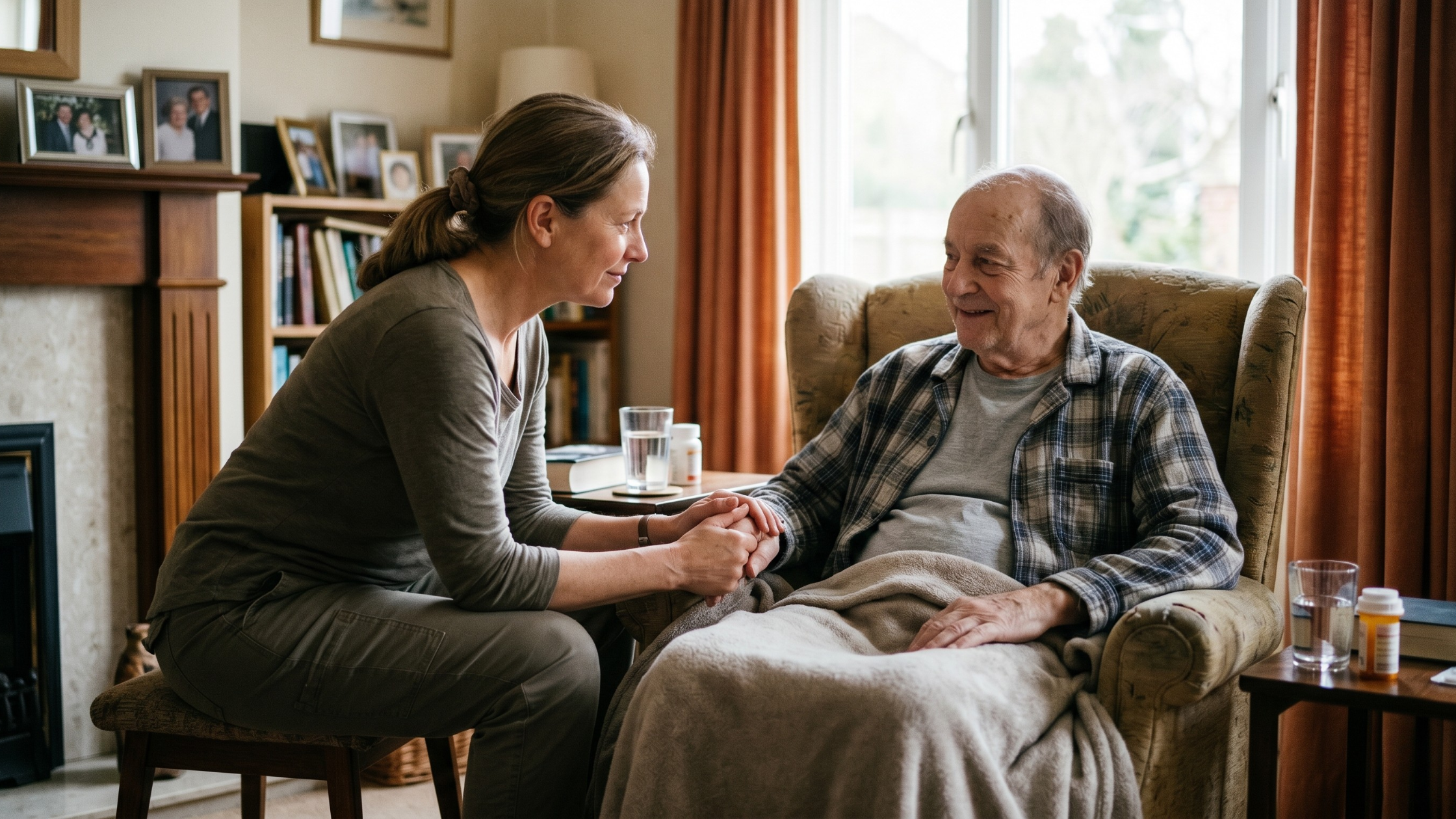
When someone you love is diagnosed with cancer, everything shifts. Your world contracts around their appointments, their medications, their bad days and their better ones. You become the person who holds the practical details together, absorbs the difficult news, and shows up — day after day — even when you have nothing left to give.
And yet, in almost every conversation about cancer, the focus is on the patient. The carer — the person holding everything together — rarely gets asked how they are doing.
This post is for you. If you are caring for someone with cancer on the Sunshine Coast, or anywhere in Australia, what you are carrying is real. And you deserve support too.
What the research tells us about cancer carers in Australia
The experience of caring for someone with cancer is one of the most demanding roles a person can take on — and Australian research confirms just how significant the toll can be.
The Australian Institute of Health and Welfare’s 2025 Informal Carers Report, drawing on the Carer Wellbeing Survey 2024 conducted by the University of Canberra for Carers Australia, found that:
- Only 17% of carers report good or excellent health, compared to 46% of other Australians
- 40% of carers report high levels of loneliness — nearly three times the rate of the general population (14%)
- 54% of carers report high to very high levels of psychological distress, up from 48% in 2020
- 59% of carers report financial stress
In Australia, 1 in 9 people are unpaid carers. Many of them are caring for someone with cancer — and many of them are doing so without adequate support for themselves.
These are not just statistics. They are the lived reality of people on the Sunshine Coast and across the country who are giving everything they have to someone they love.
The three things carers commonly experience
While every caring experience is unique, there are patterns that emerge again and again in the research and in communities like ours. Understanding them can help you recognise what you are going through — and why getting support matters.
1. Isolation
Caring for someone with cancer can be profoundly isolating. Your social world often shrinks as your caring responsibilities expand. Friends may not know what to say. Invitations stop coming. And even when you are surrounded by people, there can be a deep loneliness in feeling that nobody truly understands what your daily life looks like.
Australian research consistently shows that carers experience significantly higher rates of loneliness than the broader population. This isolation is not a personal failing — it is a predictable consequence of a role that asks so much, so quietly, for so long.
2. Burnout
Carer burnout does not arrive all at once. It builds slowly — in the sleepless nights, the cancelled plans, the conversations that always circle back to illness, the feeling that you have nothing left to give but keep giving anyway.
What makes burnout harder to recognise is that it develops gradually. By the time many carers notice it, they are already running on empty. The warning signs — exhaustion that sleep does not fix, emotional numbness, withdrawing from things you used to enjoy, a sense of resentment you feel guilty about — are easy to dismiss when you are focused entirely on someone else.
Burnout is not weakness. It is what happens when a person gives more than they have for longer than is sustainable, without enough support to replenish what they are giving.
3. Finding your way back
Many carers describe a moment — sometimes during the caring journey, sometimes after it — when they realise they have lost themselves somewhere along the way. Their own identity, their own needs, their own sense of who they are outside of the caring role, has quietly disappeared.
Finding your way back does not mean abandoning the person you are caring for. It means recognising that you are a person too — with needs that deserve to be met, and a life that deserves to be lived, even in the middle of one of the hardest seasons you will ever face.
Why carers need support — not just the patient
There is a persistent idea in cancer care that support is for the patient, and the carer’s role is simply to provide it. This idea is both wrong and damaging.
When carers are not supported, burnout follows. And when a carer burns out, the person they are caring for is affected too. Supporting the carer is not separate from supporting the patient — it is part of the same picture.
More than that, carers are people in their own right. They are experiencing their own grief, their own fear, their own profound disruption to life as they knew it. The fact that they are not the one with the diagnosis does not make their experience less real or less worthy of care.
Research published in the Journal of Cancer Survivorship (Baguley et al., 2023) found that cancer patients and carers alike reported feeling unsupported and isolated, particularly after active treatment ended. The need for connection, community, and a space to process the experience does not disappear when treatment finishes — for the patient or for the people who walked alongside them.
What cancer carer support looks like on the Sunshine Coast
Support for carers does not have to mean formal counselling or clinical intervention — though those things have their place. Sometimes what helps most is simply being in a room with people who understand, or finding a practice that gives you somewhere to put down the weight you have been carrying.
At CanSurvive Australia, our doors are open to carers as well as those living with cancer. You do not need to be the patient to belong here.
Monthly support group
Our monthly support group meets at Kon-Tiki Business Centre in Maroochydore and is open to anyone affected by cancer — patients, survivors, and carers. There is no agenda and no pressure. It is simply a space to connect with others who genuinely understand, in a warm and welcoming environment.
For many carers, finding a space where they are seen as a person — not just as a support mechanism — makes a significant difference.
Sound healing
Sound healing is a gentle, non-invasive complementary therapy that uses therapeutic sound to support relaxation, reduce anxiety, and promote a sense of wellbeing. A 2025 study published in Palliative Medicine Reports (Shimotsuura et al.) found that natural sound therapy reduced anxiety, tiredness, and breathlessness, and improved sleep satisfaction in cancer patients. The same principles apply to those supporting them.
For carers carrying significant stress and exhaustion, sound healing offers a rare opportunity to simply stop, be still, and let the nervous system rest.
Energy healing
Energy healing is another carefully selected complementary therapy available at CanSurvive. Like sound healing, it works with the body’s natural capacity for rest and restoration — supporting emotional as well as physical wellbeing. Many carers who access energy healing describe it as one of the few times in their week when they are not thinking about anyone else’s needs.
These are not replacements for medical care or professional psychological support. They are complementary — designed to work alongside whatever else you may be receiving, and to give you something that is just for you.
You are welcome here
If you are caring for someone with cancer on the Sunshine Coast, you are part of the CanSurvive community too.
You are allowed to grieve. You are allowed to be exhausted. You are allowed to feel all of it — the love, the fear, the frustration, the moments of unexpected beauty in the middle of something very hard — and still reach out for support.
Caring for yourself is not selfish. It is not a betrayal of the person you are caring for. It is the only way you can continue to show up for them, and for yourself, over the long journey ahead.
We are here. And we are glad you found us. 💚
Sources:
Australian Institute of Health and Welfare. (2025). Informal Carers. Retrieved from https://www.aihw.gov.au/reports/australias-welfare/informal-carers
Mylek, M. and Schirmer, J. (2024). Carer Wellbeing Survey 2024 Report. University of Canberra for Carers Australia.
Baguley, B.J. et al. (2023). Access to nutrition services and information after active cancer treatment: a mixed methods study. Journal of Cancer Survivorship, 18(1), 176–185.
Shimotsuura, Y. et al. (2025). Effects of high-resolution natural sound with inaudible high-frequency components on healing, symptoms, and sleep satisfaction in terminally ill cancer patients. Palliative Medicine Reports, 6(1), 53–60.
📌 This content is for educational purposes only and is not a substitute for medical advice. Please consult your healthcare team for guidance specific to your situation.